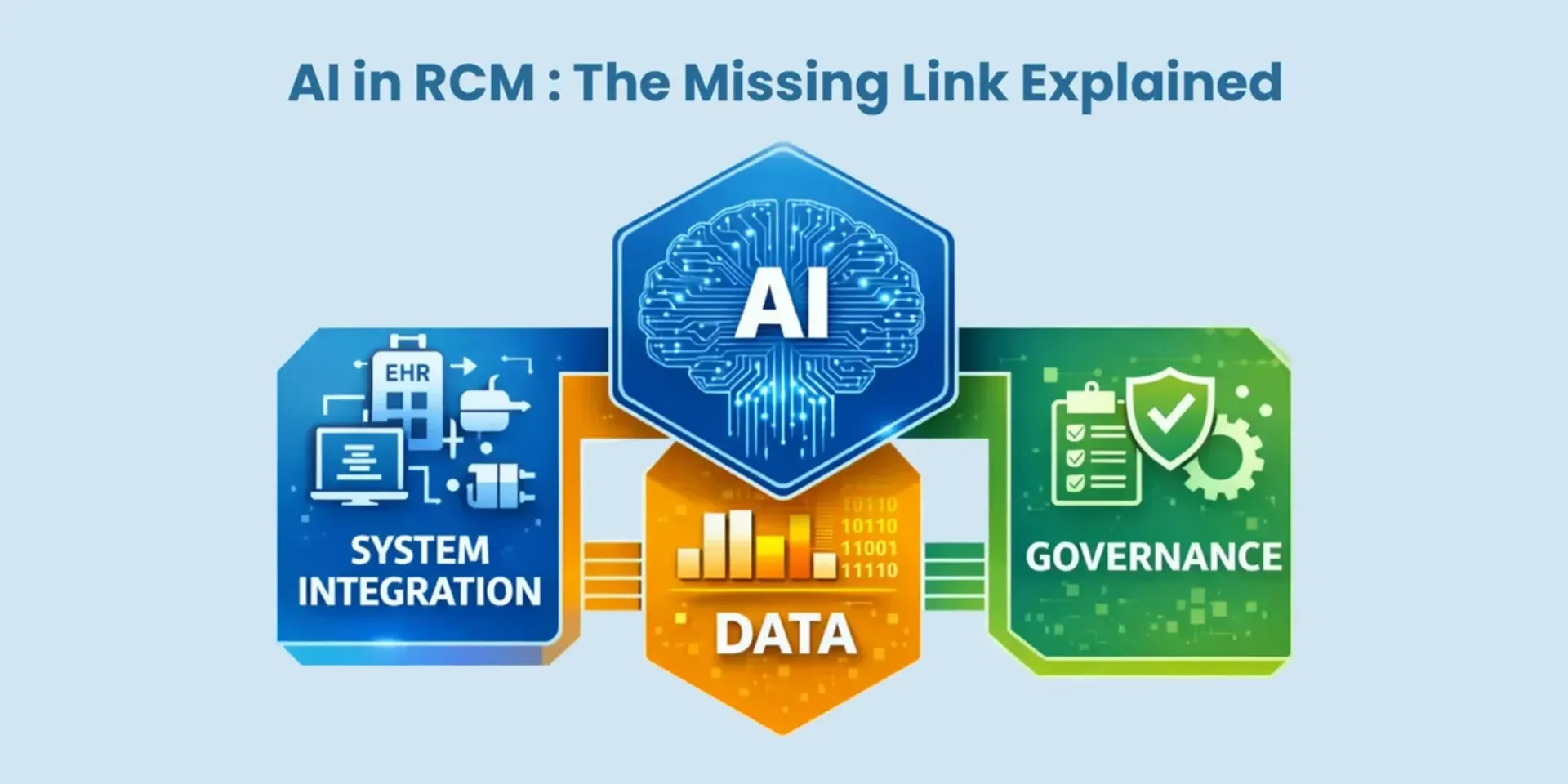
A recent Black Book flash survey of 149 US revenue cycle executives surfaced a truth many healthcare providers quietly acknowledge but few say it loud:
AI isn’t falling short in healthcare revenue cycle management (RCM) because its algorithms are weak; it’s falling short because the data underneath them is.
The survey doesn’t point to a failure of an RCM technology. Instead, it reveals foundational cracks in the RCM ecosystem, explaining why even the most advanced technologies like AI and analytics struggle here to deliver the real impact.
What the Survey Findings Really Revealed
- 74% cited poor data quality as the biggest barrier to AI success in RCM.
- 76% identified AI–EHR integration a major operational challenge.
- Documentation and governance gaps continue to undermine AI outcomes.
- Only 20% believe their RCM partners address data quality well.
Perhaps most telling: nearly 80% admitted they have stalled or discontinued AI use cases because they don’t trust the underlying data.
And this hesitation explains why a growing number of healthcare providers are rethinking AI strategy across their revenue cycle.
AI in Revenue Cycle Management: Capability vs. Reality
At a surface level, Black Book’s findings highlighted challenges with AI adoption in RCM. At a deeper level, it exposes the widening gap between AI narratives and operational reality in healthcare revenue cycle management.
The takeaway is clear: While the algorithms are ready, the data isn’t.
The Hard Truth
AI outcomes are only as reliable as the data they consume. This is because AI’s functionality largely depends on how clean and structured the data is and how seamlessly AI integrates with EHR, for it to deliver results that can be trusted.
However, what’s being overlooked is that:
- Revenue cycles operate amid inconsistent documentation and brittle interfaces.
- Data quality is mostly compromised, resulting in “garbage in/garbage out” outcomes.
- Poor integration with EHR and PM systems derails the whole purpose of AI.
While AI algorithms largely assume the foundations underneath them are supported by clean data, accurate documentation, and seamless EHR integrations, they’re often sidelined on the RCM floor, where gaps start showing up in AI use cases like:
- Denial prevention analytics
- Underpayment detection
- Propensity-to-pay modeling
And it is for the same reason that AI projects often fail to scale beyond pilots even when early results look promising.
When the Foundation Is Weak, the Entire Revenue Cycle Falters
The survey highlights four structural constraints throttling AI impact:
- Data Quality Treated as an Afterthought: 66% of respondents said budgets mostly flow toward licenses and models, while data quality and governance remain ignored. The result: coding inconsistencies, missing or delayed charge data, documentation gaps, and avoidable downstream rework.
- Governance Not Embedded into Workflows: Only 14% admitted having data governance built into their AI initiatives. Most organizations simply assume data reliability until misleading insights erode their trust.
- Fragile EHR & PM Integrations: 76% cited poor integrations causing interface complexities, mapping issues, and breakage during system upgrades that disrupt operational workflows and further derail AI outcomes.
Another stark revelation from the survey: 60% of executives believed their RCM technology partners gloss over data quality issues.
That disconnect fuels skepticism and leads many AI initiatives to stall or be abandoned after early pilots.
No denying, healthcare leaders feel AI ambitions are running ahead of data reality.
So Where’s the Real Opportunity?
The next wave of RCM transformation won’t come from adding more tools. It will come from fixing what’s sit beneath them. And that’s where the shift needs to be made—from AI as an overlay to AI as embedded revenue cycle intelligence.
How Jindal Healthcare’s AI Engine Addresses These Barriers Upfront
At Jindal Healthcare, we’ve always worked toward helping healthcare providers simplify their RCM with AI that comes with capabilities around core realities to deliver outcomes that matter.
Our revenue cycle management solution works on one truth: revenue cycle intelligence only works best when it’s anchored in clean, contexual data, embedded into workflows, and seamlessly integrated with existing systems.
Our RCM solution is, therefore, designed around simple but radical premises:
- Data Quality Is Embedded into Workflows
Instead of relying on downstream analytics to explain revenue leakage, our revenue cycle AI embeds intelligence into core workflows to identify and correct issues early before they escalate into denials and move into complex AR layers.
It works on the principle that AI cannot optimize revenue if it doesn’t first normalize, validate, and contextualize the data flowing through the revenue cycle.
And here’s where our AI engine changes the game. Instead of sitting on top of broken workflows, it functions as an operating system for RCM—a unified intelligence layer that continuously ingests data and improves data quality, orchestration, and decision-making across the lifecycle by acting as:
- A single claim intelligence layer that normalizes data into a structured format
- A real-time data integrity engine that validates inputs at the point of action
- A junior analyst that flags missing or conflicting data before claims are generated
- Governance Is Operational Across All RCM Stages
Rather than treating data governance as a separate function, Jindal Healthcare’s AI is tied directly to decisions. Root cause analysis (RCA), documentation gaps, and revenue risk signals are made visible to frontline teams via a closed feedback loop in real time for instant corrective actions.
Instead of assuming data reliability, our solution enforces it by:
- Validating ICD/CPT coding against clinical documentation
- Flagging gaps in documentation against payer rules
- Making data error rates and coverage gaps visible
- Explaining why actions are recommended
- Showing source data and confidence levels
- Routing edge cases to human experts with next-best actions
- Embedding outcomes back into the system to prevent further slips
The result is a closed-loop learning system where governance strengthens with every claim processed.
- AI Is Built for True Realities, Not Fancy Promises
While many AI tools in the market promise mere rule-based automation across the revenue cycle, our approach to AI in RCM is strategic. This means:
- Deploying capabilities where they can support and deliver
- Clean, structured, contexual data for AI to work on
- Human-in-the-loop (HITL) support for nuanced cases
This aligns with what revenue leaders in the survey said they want: clarity on which AI use cases can be trusted and which should wait.
- Integration Is Seamless with EHR Systems
Our RCM solution is EHR- and PM-agnostic and remains stable through upgrades, data mapping changes, and operational variability—addressing the structural drag concern in the survey.
It:
- Understands how a claim through the revenue lifecycle
- Learns patterns from historical and real-time data, including where claims typically break, which codes get denied, and which payers underpay
- Acts autonomously within the EHR to prevent denials, accelerate resolution, and improve cash flow—without adding FTEs
End-to-End Intelligence, Not Point Automation
Unlike other RCM solutions with limited capabilities, our solution orchestrates the entire revenue lifecycle:
- Eligibility Verification: Real-time checks via API, Voice AI payer calls, EPR calculation
- Prior Authorization: Documentation validation against payer-specific logic with HITL escalation
- Coding: Coding validation, mismatch detection, and claim queueing for submission
- Payment Posting: Underpayment detection and automated appeals
- AR: ROI-based claim prioritization and autonomous resolution via appeals/follow-ups
- Analytics: Executive dashboards with drill-downs to the nth degree for informed decisions
All within a single operating layer that supports structured data, governance, and seamless integration with legacy systems.
The Impact Providers Are Seeing
Providers using our RCM solution report measurable, system-wide outcomes:
- 35% increase in revenue
- 50% reduction in cost to collect
- 60% reduction in 90+ days AR
These gains don’t come from more AI tools. They come from better foundations for AI to work.
The Bottom Line
The Black Book survey makes one thing clear: the next wave of revenue cycle transformation won’t be driven by flashy algorithms. It will be driven by platforms that do the unglamorous work of data quality, governance, and integration by default.
Jindal Healthcare’s revenue cycle intelligence engine drives that shift. Not with AI as a promise but with AI as an operating reality.
Because choosing the right RCM partner goes beyond choosing the revenue cycle management solution provider. It’s about finding a revenue cycle optimization ally who understands the ground reality to deliver operational success with AI that integrates seamlessly, feeds on clean data, and supports governance to realize the true potential of your revenue cycle, faster and smarter.
Book an expert consultation to see how stronger foundations can unlock smarter revenue cycle performance.